There's a particular kind of meal you carry with you long after you've paid the bill and stepped back out into the London air. Not because it was expensive, not because the room was beautiful—though it may well have been both—but because something about it felt true. The food tasted like someone actually cared where it came from. The story behind it was real. The people serving it knew what they were talking about.
That's what Indian fine dining in London, at its best, delivers. And that's what this guide is here to help you find.
London's relationship with Indian food has always been deep, but it has changed enormously. What was once a landscape of high-street curry houses and late-night tandoori joints has quietly — and then not so quietly — evolved into something far more interesting. A generation of restaurants has emerged that go back to the source: to the regional traditions of the subcontinent, to royal recipes, to the kind of cooking that belongs to families, not menus. They've brought that cooking into landmark buildings, surrounded it with craft cocktails and Maharaja-era antiques, and asked it to stand alongside the finest dining London has to offer.
This guide covers what Indian fine dining in London actually means in practice, what to look for, what to order, and what to expect—including an in-depth look at Colonel Saab, one of the city's most celebrated luxury Indian restaurants, with locations at Holborn Hall and Trafalgar Square.
What Defines Indian Fine Dining in London?
Indian fine dining in London is defined by curated menus of regionally specific dishes prepared by trained chefs, premium presentation, luxury interiors, and service standards on par with the city's best European restaurants.
That might sound like a formal definition, but the lived experience is far more visceral. It means that the dish in front of you has a story that predates the restaurant. The rasam you're sipping isn't just a warm opener—it's a South Indian spiced tomato broth that has been made in Tamil kitchens for generations, and tonight it arrives in a beautiful bowl with mini idlis alongside it, each one an invitation to dip and ask where exactly this came from. The staff know the answer. That's the difference.
The shift away from homogenised Indian food
For decades, Indian restaurants in Britain operated within a surprisingly narrow range of the subcontinent's actual cuisine. Balti, tikka masala, rogan josh—dishes shaped as much by British appetites as by Indian tradition. There's nothing wrong with those dishes done well. But they represent perhaps two or three of the dozens of distinct regional food traditions that make up Indian cooking.
Fine dining Indian restaurants in London have broken out of that template entirely. Today, a serious Indian menu might take you from a South Indian tomato rasam to a Rajasthani lamb preparation to a Bengali Mishti Doi Cheesecake—a sweetened yogurt cake with Bengal lime and jaggery syrup—in a single evening. You're not eating Indian food. You're eating food from specific places, made by specific traditions, presented with the care and precision that cuisine deserves.
The hallmarks of a truly luxury Indian experience
When you're evaluating an upscale Indian restaurant in London, the markers of quality to look for include:
• Menus curated by named culinary authorities, not assembled from generic templates
• Chefs with formal training and a genuine connection to the food's regional origins
• Tasting menus that build a coherent narrative across courses
• Wine and cocktail programmes designed specifically to complement the food
• Private dining spaces for special occasions
• Interiors that tell you something real about India — not themed decoration, but genuine objects and genuine stories
At Colonel Saab, the kitchen is led by Executive Chef Sohan Bhandari, whose menu draws on regional cooking traditions from across the Indian subcontinent. The building is filled with original Indian art, antique furniture, and objects made for Maharajas. None of these are decorative choices. They are arguments. They say this cuisine, this culture, this history—it deserves to be here.
The Story Behind the Food — Why Heritage Matters
The most enduring Indian fine dining restaurants in London are built on genuine stories. Not brand narratives. Not marketing copy. Real heritage — the kind that shows up in the food, in the objects on the walls, in the way staff talk about what they're serving.
This matters more than it might initially seem, because fine dining has always been about more than the plate. It's about context. A single dish tastes different when you understand where it comes from, who made it first, what occasion it was made for. Great restaurants know this and build everything around it.
Colonel Saab: a love letter to India
Colonel Saab was created by Roop Partap Choudhary as a tribute to his parents: Colonel Manbeer Choudhary, who served in the Indian Army, and Mrs. Binny Choudhary, who traveled with him across the Indian subcontinent—through Rajasthan, through the south, through the hill stations, and through the plains, eating at noble banquets and roadside dhabas alike, gathering stories and recipes and a collection of objects that now fill Colonel Saab's dining rooms.
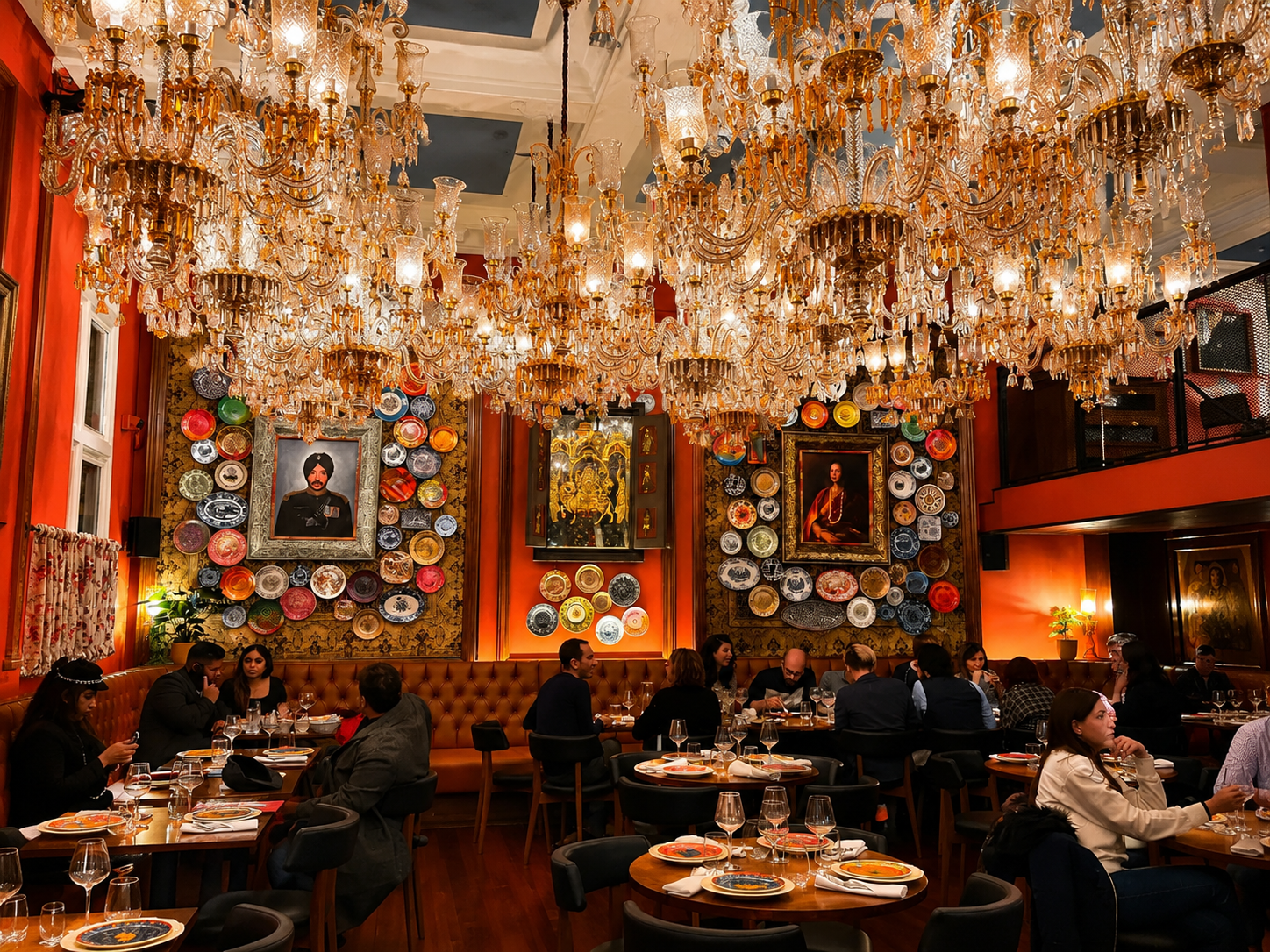
Roop described the restaurant as a 'love letter' to his family. If you know what to look for, you can read that letter in the room around you. The chandeliers from Firozabad. The century-old antique furniture. The Persian silk carpets. The framed family photographs on the walls of the Holborn location. The military artifacts at Trafalgar Square. Even the old-style jazz that plays softly through the dining room — an echo of the Anglo-Indian world Colonel Manbeer and his wife moved through.
When guests report that the Holborn general manager, Atul Joshi, offers them a history tour of the space — walking them through the building's past as the old Holborn Town Hall and explaining the significance of the objects around them — they often describe it as one of the most memorable parts of the evening. That's not a coincidence. It's what happens when a restaurant is built on genuine love for what it's doing.
At Colonel Saab, the menu goes beyond what most London Indian restaurants have ever attempted. Regional specialties from across the subcontinent—many appearing on a London Indian restaurant menu for the very first time—sit alongside dishes that most diners in this city have simply never encountered. The best fine dining Indian restaurants treat this as an opportunity—not to confuse, but to open doors. Colonel Saab is built on exactly that philosophy.
Two Landmark London Locations
Colonel Saab, Holborn Hall — dining in a Grade II listed landmark
Address: 193–197 High Holborn, London WC1V 7BD
Nearest transport: 3-minute walk from Holborn Tube (Central and Piccadilly lines)
The Holborn location occupies what was once the grand Holborn Town Hall—a Grade II listed building with the bones of a public building and the warmth of somewhere that has been genuinely reimagined, not just decorated. Natural daylight pours through tall windows during afternoon hours. Crystal chandeliers catch it. Original Indian art and antique furniture fill the walls and corners.
This is also where you'll find the Afternoon Tea service (Monday to Friday, 2:30pm–4pm), the Lunch Tiffin, and the two private dining rooms—the Memsaab Rooms with oak-panelled walls (up to 30 guests seated) and the Mezzanine, which can accommodate up to 50.
Opening hours: Monday to Saturday — Bar 12 noon–11:30pm | Lunch 12 noon–2:30pm | Dinner 5:30pm–10pm | Sunday — Dinner 5pm–9pm | Monday to Friday — Afternoon tea 2:30pm–4pm.
Colonel Saab, Trafalgar Square — Indian luxury at the heart of the capital
Address: 40–42 William IV Street, London WC2N 4DD
Nearest transport: 1 minute from Charing Cross Tube; 3 minutes from Embankment; 2 minutes from Leicester Square
The Trafalgar Square location opened after Holborn's success and has quickly developed its own identity. The interior features a marble bar, a glass roof, a balcony overlooking a central atrium, and the signature Firozabad glass chandeliers. Burnt orange walls are hung with Indian artworks and military artifacts that nod to the Choudhary family story.
Its position—steps from the National Gallery, minutes from the West End's major theatres, close to Westminster—makes it a natural fit for pre- and post-show dining, tourist evenings in Central London, and business entertaining that calls for proximity to the city's most recognizable landmarks.
What to Expect on the Menu — A Guided Tour
Colonel Saab's menu is a journey from South Indian tomato soups to Rajasthani lamb curries to Bengali desserts, with cocktails created to work alongside the food. Here's how to navigate it.
The Memsaab's Tasting Menu — the centrepiece experience
From £85 per person | Drinks pairings: cocktails £60 | wine £60 | Champagne £105 (groups of 6+)
If you're visiting for the first time, for a special occasion, or because you genuinely want to understand what Colonel Saab's kitchen is capable of, the tasting menu is where to start. It runs to five or six courses and is curated by Chef Sohan Bhandari to tell a coherent story: each dish is connected to a region, a memory, or a family table.
A typical journey begins with a South Indian tomato and lentil rasam—light and bracingly spiced—served in a shot glass with puffed pastry bites and mini rice cakes for dipping. Then the Raj Kachori arrives: a round, crisp chickpea shell filled with mango, tamarind, and coriander sauces that collide on your tongue in a way that's impossible to predict. A palate cleanser of Alphonso mango sorbet. Then the main course is a thali—a tray of smaller dishes: a Sunday Lamb Curry in a dark burgundy sauce, a Nadan Fish Curry with Malabar paratha, or a vegetarian kofta. Alongside each: cumin potatoes, dal makhani, steamed rice, and buttery naan.
Dessert brings the drama. A Mishti Doi Cheesecake — Bengali sweetened yoghurt with Bengal lime and jaggery syrup. A coco-pista tart with raspberry mousse and passionfruit pearls. At Trafalgar Square, desserts sometimes arrive with theatrical flourish — a coconut pannacotta suspended above dry ice, a dark chocolate silk cake with candy floss. A perfectly dramatic ending for London's theatre district.
The staff are notably well-briefed throughout. Each course is explained — where it's from, why it's here, what you're tasting — without feeling like a lecture. This is the kind of service that makes a tasting menu feel like a conversation.
Set menus at £65 and £85
For those who want a curated, multi-course experience without the length of the full tasting menu, the set menus are the answer. Well-suited to business dinners where the food needs to be excellent but the evening has a time constraint, and ideal for groups with varying appetites.
Signature à la carte dishes worth knowing
• Shahi Pumpkin — silky tomato sauce, butter-poached vegetables, pickled spiced grilled cottage cheese, and finished with pumpkin seeds. A dish that makes the case for vegetarian fine dining without apology.
• Kolapuri Lamb Chop — Maharashtrian spicing applied to lamb with a marinade that clings to every bite. One of the tasting menu's standout starters, and available à la carte.
• Kandhari Paneer Tikka — cottage cheese filled with prunes and pomegranate, served with tomato, garlic, and mustard salsa. Clay oven-cooked, it reconsiders what paneer can be.
• Anglo-Indian Chicken Chop — Madras-spiced pulled chicken cutlet with salad and tomato raisin relish. A dish that bridges two culinary worlds cleanly.
• Slow Cooked Free-Range Chicken — corn-fed breast cooked in a clay oven, served with saffron and cardamom sauce. Restrained, elegant, and precisely executed.
• Banarasi Amrood Ki Chaat — guava cone chaat with tamarind chutney, raspberry sauce, spiced cream, and crisp gram flour noodles. Street food intelligence applied to fine dining presentations.
• Dahi Sev Puri — one bite, sweet-spicy-cooling. A textbook chaat moment served as an amuse-bouche—and still a surprise every time.
• Colonel Saab's Smoked Lamb Shank — long-cooked, deeply flavored, one of the restaurant's most talked-about signature dishes.
• Figs Poached in Assam Tea Cognac — better than its description. A dessert that feels like a summary of the Colonel Saab ethos: classical Indian ingredients, an unexpected preparation, results that linger.
• Vegan Short-Grain Rice Pudding — rhubarb and raspberry compote, pistachio crumble, sliced pistachio. Evidence that the dessert menu is not an afterthought.
• Butter Chicken and Dal Makhani — Colonel Saab's versions of these familiar dishes consistently draw comparisons to high-end Delhi restaurants, not London approximations. The dal makhani runs slightly spicier than the standard — worth knowing if spice tolerance is a consideration.
The Lunch Tiffin
The traditional Lunch Tiffin is available at both locations on weekdays — tiered containers stacked with different dishes, a great expression of Indian food culture and an excellent weekday business lunch. Visually distinctive, filling without being heavy.
Indian Afternoon Tea — champagne meets chaat
Available at Holborn Hall, Monday to Friday, 2:30pm–4pm
One of the most original afternoon teas in a city that takes afternoon tea extremely seriously. The three-storey stand arrives with finger dhokla sandwiches with coriander and mint chutney and onion bhajia with pickle chaat masala on the first tier; raisin scones with clotted cream and strawberry jam alongside coconut and Earl Grey cookies on the second; saffron and rose shrikhand macarons on the third.
To drink: premium teas, infusions, or the signature Three C option — Chai, Charlie, and Champagne — featuring Taittinger Brut, Rosé, and Nocturne alongside excellent chai. An afternoon in the chandelier-lit Holborn dining room, with its walls of artwork and family photographs, is a genuinely beautiful way to spend a few hours in Central London.
The Atmosphere — Where the Setting Is Part of the Experience
One thing that separates Colonel Saab from restaurants that simply serve good food in a nice room is that the interior is working hard. Every element — the Firozabad chandeliers, the century-old Maharaja furniture, the Persian silk carpets, the family photographs, the military artefacts — is part of a coherent argument that Indian culture is as rich, layered, and worthy of reverence as any European tradition. You are not in a themed restaurant. You are in a place that is genuinely trying to show you something.
At Holborn, that argument is made inside a Grade II listed Victorian building — the former town hall, with all its architectural weight. At Trafalgar Square, it's made inside a space with a marble bar and a glass roof that lets the London sky in above a Firozabad chandelier. Both rooms reward attention.
The music matters too: old-style jazz, sometimes Indian classical, always low enough that conversation is easy. The bar is a serious pre-dinner or post-theatre destination. The Kunwar cocktail — Roop Partap Choudhary's personal creation, blending Chivas 15 with Indian spice-infused vermouth, Campari, and rhubarb — is worth ordering before you even look at the food menu.
Private Dining — For Occasions That Call for More
Colonel Saab offers some of the most atmospheric private dining rooms in Central London. At Holborn Hall, the Memsaab Rooms accommodate up to 30 guests seated, with oak-paneled walls and original Indian artwork. The mezzanine accommodates up to 50. Both are available for corporate events, birthday celebrations, anniversary dinners, and wedding parties.
Bespoke menus are available for private events. If you are hosting international guests or planning something that needs to feel genuinely special, the combination of setting and food makes a strong case for choosing Indian fine dining over the European alternatives that typically dominate London's corporate entertaining circuit.
Private dining enquiries: reservations@colonelsaab.co.uk | 020 8016 6800
What Guests Say — An Honest Picture
The consistent threads across hundreds of reviews are worth taking seriously, because they tell you something about what actually happens when you go.
On the food
Guests describe dishes as surprising—not in a challenging way, but in the way that food surprises you when it does something you weren't expecting with ingredients you thought you knew. The tasting menu in particular is described as building like a well-told story. People leave the table still thinking about specific bites.
On the service
Warm, well-informed, and personable rather than formal. Staff are consistently described as knowledgeable about the food's origins rather than simply reciting descriptions. General Manager Atul Joshi at Holborn is mentioned by name in multiple reviews for his practice of walking guests through the restaurant's history and collection.
On the value
Colonel Saab is more expensive than a neighbourhood Indian restaurant. It is also a fundamentally different experience — the food, the space, the service, the narrative. Those who go in with the same frame of reference they'd bring to European fine dining of equivalent quality tend to leave as regulars.
Ready to Book?
Indian fine dining in London has arrived at a genuinely remarkable moment. The question is no longer whether it belongs in the same conversation as European fine dining — it clearly does. The question is where to go and what to order when you get there.
The tasting menu is the best introduction. The afternoon tea is the best excuse for a weekday afternoon. And the private dining rooms are among the most distinctive event spaces in Central London.
How to Book — Practical Information
Holborn Hall: 193–197 High Holborn, London WC1V 7BD — 020 8016 6800
Trafalgar Square: 40–42 William IV Street, London WC2N 4DD — 020 8016 6800
Email: reservations@colonelsaab.co.uk
Reserve your table at colonelsaab.co.uk →
View menus and PDF downloads at colonelsaab.co.uk/menu →
A few things worth knowing before you go
• Dress code: Smart casual to smart. The space calls for something beyond jeans and a t-shirt, but there's no formal requirement.
• Dietary requirements: Halal, vegan, vegetarian, gluten-free, and dairy-free options are available — mention at the time of booking.
• Pre-theatre dining: The Trafalgar Square location works well for West End theatre-goers; the kitchen manages pre-theatre pacing reliably.
• Parking at Holborn: Q-Park Newport Place, NCP Covent Garden (Parker Street), Bloomsbury Square Car Park. Congestion Charge applies.
• Service charge: A discretionary 12.5% service charge is added to the bill.
FAQs
What is the best Indian fine dining restaurant in London?
Colonel Saab — with locations at Holborn Hall and Trafalgar Square — is consistently cited among the finest Indian fine dining experiences in London. The menu is prepared by Executive Chef Sohan Bhandari, with dishes spanning the regional breadth of the Indian subcontinent.
How much does Indian fine dining in London cost?
At Colonel Saab, set menus are priced at £65 or £85 per person. The Memsaab's Tasting Menu starts from £85, with optional drinks pairings from £60. For a full dinner with drinks, expect to spend £90–£130 per head.
What is included in the Afternoon Tea?
The Indian Afternoon Tea includes a three-tiered stand with finger dhokla sandwiches, onion bhajia with chaat masala, raisin scones with clotted cream and jam, coconut and Earl Grey cookies, and saffron and rose shrikhand macarons. The signature Three C upgrade includes Taittinger Brut, Rosé, and Nocturne alongside excellent chai.
Can I book for a large group or private event?
Yes. Holborn Hall offers the Memsaab Rooms (up to 30 guests seated) and the Mezzanine (up to 50 guests). Bespoke menus are available. Contact reservations@colonelsaab.co.uk or 020 8016 6800.
Is Colonel Saab near Westminster or Trafalgar Square?
The Trafalgar Square location on William IV Street is within minutes of Charing Cross, Embankment, and Leicester Square stations — one of the most accessible upscale Indian restaurants near Westminster in Central London, and an excellent choice for pre-theatre dining.
Does Colonel Saab cater to dietary requirements?
Yes. Both locations offer halal, vegan, vegetarian, gluten-free, and dairy-free options. Always mention your requirements at the time of booking.
What makes Colonel Saab different from other Indian restaurants in London?
Colonel Saab goes beyond both the street food trend and the legacy curry house format. The menu features regional Indian specialities — some appearing on a London Indian restaurant menu for the first time — prepared by Executive Chef Sohan Bhandari. The restaurants occupy heritage buildings filled with original Indian art, Maharaja-era antiques, and objects that are part of a real family story. The result is an experience that rewards attention in ways that most restaurants, Indian or otherwise, simply don't.
